Sportsproptech

Sportsproptech

SportsPropTech runs sports prop firms under their own names. Traders pay for a challenge and pick from real odds with the firm's balance, and the ones who pass get funded.

Designed the second version of the trader's platform on desktop and mobile: the sportsbook with odds laid out the way each sport is read, match pages with dozens of markets, the betslip, and open and settled bets down to which leg of an accumulator lost.

Role
Product Designer
Designed
Trader platform, web and mobile
Market
Sports prop firms
Coverage
15+ sports, 50+ leagues
The problem
Traders judge it against the sportsbooks they already use, while every pick sits on a challenge account with its own balance and rules, under whichever firm's name is on the platform.
What I owned
The trader's side end to end: the three-column terminal, odds shaped by each sport, match pages, the betslip and its states, bet tracking, and the same terminal on a phone.
View Live

Overview

SportsPropTech builds the platform that sports prop firms launch on. A trader buys a challenge, gets an account with a balance, and makes picks against real odds under the firm's rules. Pass, and the firm funds them. I designed the second version of the trader's platform, on desktop and mobile: the sportsbook itself, the betslip, and the bets that are open and settled.

The problem

It has to work like a sportsbook

Traders already know how a sportsbook works, and they judge this one against the ones they use.

Every firm launches the platform under its own name, so the design has to hold up in any firm's colours. It is black and grey, with one blue for the things you act on.

What makes it a prop firm is the account. A trader can run several challenges at once, each with its own balance and rules. That layer lives in the header, clear of the odds: which account you are on, its balance with a toggle to hide it, and Buy a Challenge. Selling challenges is how a firm earns, so that button is on every screen.
Layout

Three columns that stay put

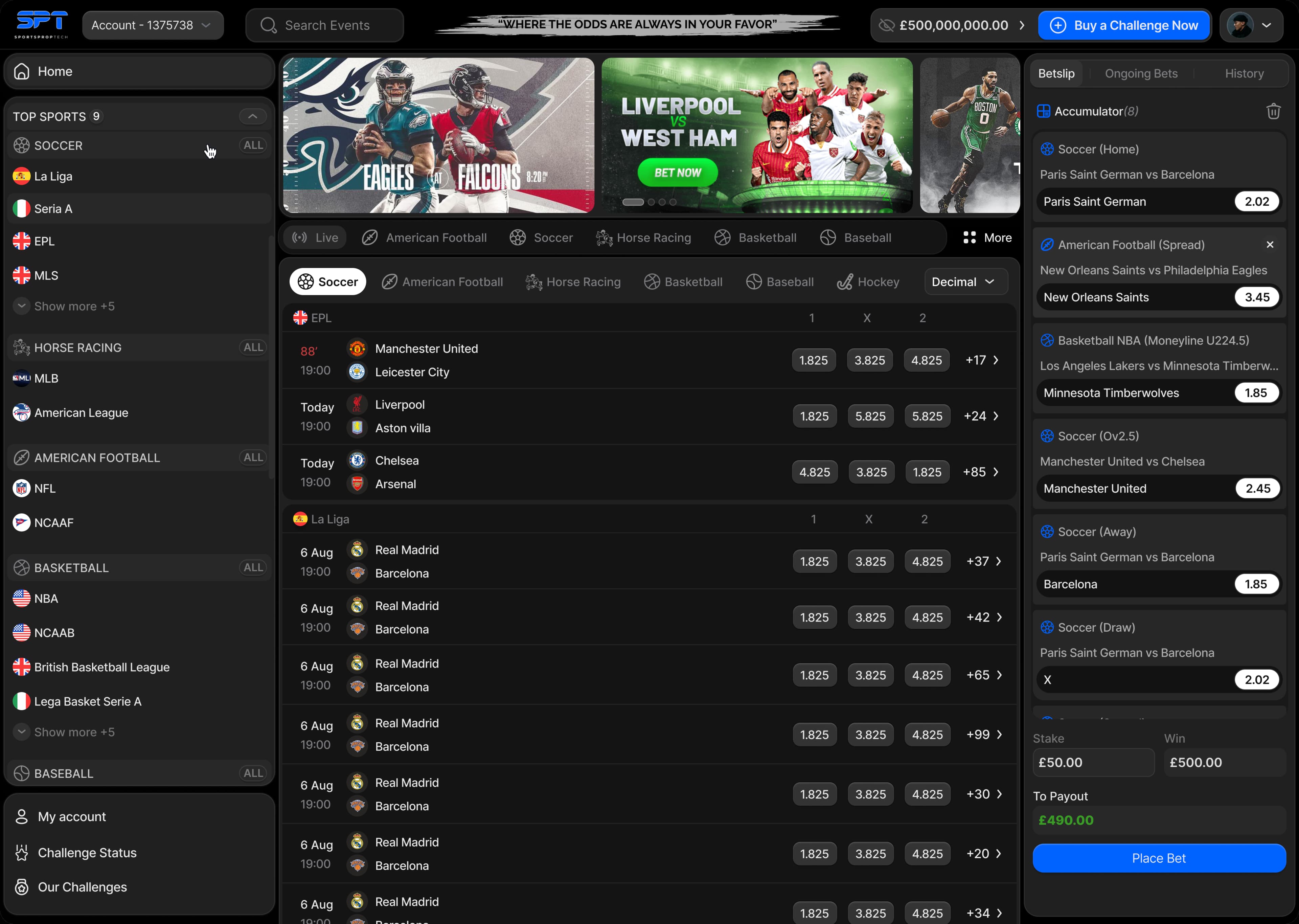
Sports on the left, odds in the middle, the betslip on the right, on every screen.

Picking is a loop: tap a price, watch it land in the slip, go back for the next one. So the slip stays open on the right, and nothing slides over the odds to show it.

The left rail lists each sport with its leagues underneath, from soccer down to snooker, and it runs long. A note on the canvas for engineering asks for that panel to scroll inside itself, so the odds and the slip stay where they are while you look for a league.

The SportsPropTech terminal: sports and leagues on the left, the day's soccer matches with 1, X and 2 prices in the middle, and an accumulator of eight in the betslip on the right
The soccer list, with an accumulator building in the slip.

Odds

Each sport keeps the shape its bettors read

A football fan expects three prices, an NFL fan expects a line, and a racing fan expects one price per horse.

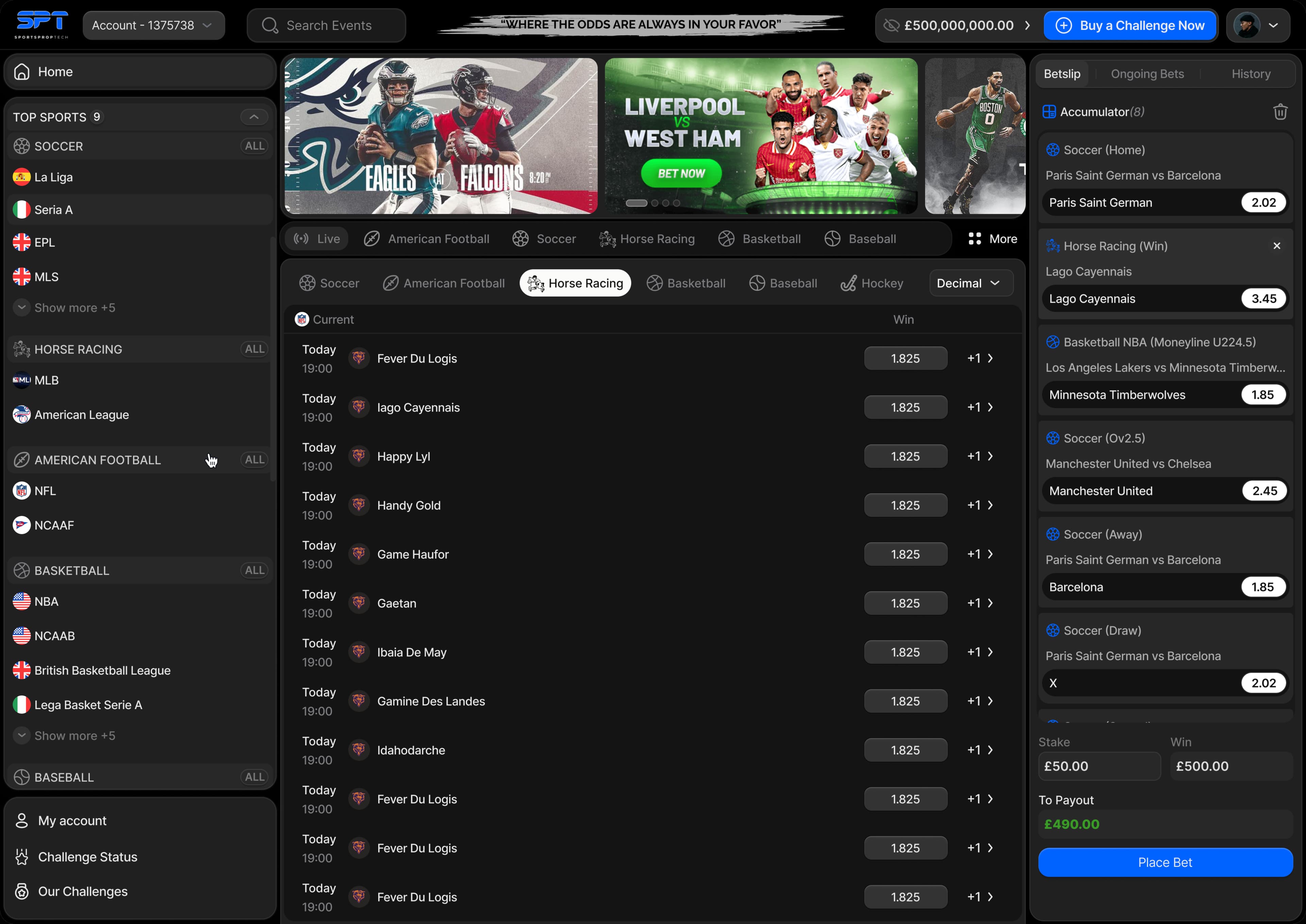
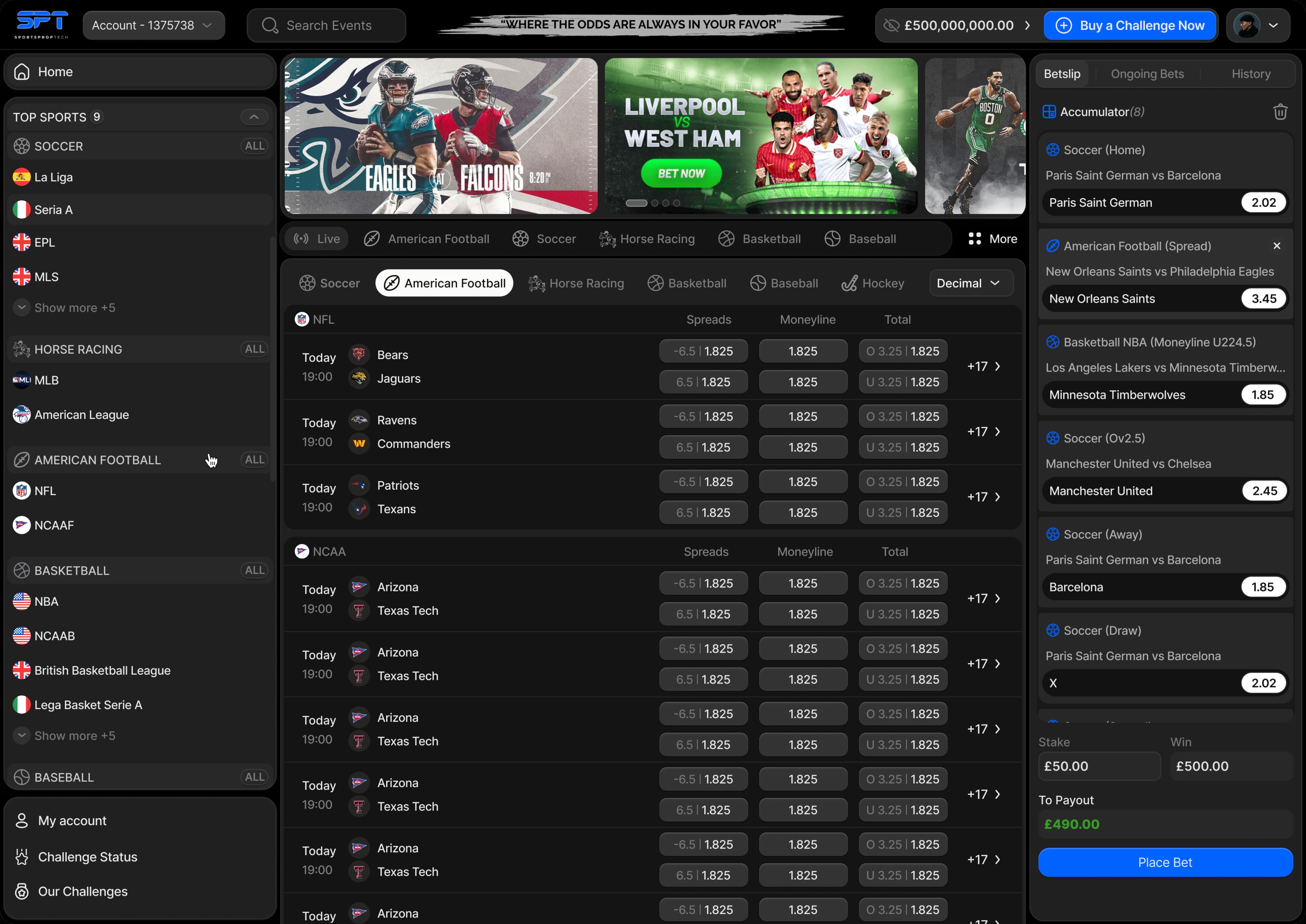
In the earlier pass at the top of this page, soccer borrowed the American columns: spread, moneyline and total. That reads wrong to anyone who bets on football, where a draw is a result. So the list takes its columns from the sport. Soccer shows 1, X and 2. American football gives each team its own row, with the line and the price in the same button, because a price means nothing without the line it is for. Racing shows one Win price per runner.

The odds format is the trader's choice too: decimal, fractional or moneyline, from the menu at the top of the list. Firms sell to traders in different countries, and each country reads odds its own way.

American football with a line on every price, and racing with one price per runner.

Markets

Dozens of markets on one match

The list shows three prices. Open the match and every market has its own shape.

Each market is a group that collapses, with a search across all of them in the header. Inside a group the buttons follow the market: two-way markets in pairs, three-way in threes, corners and cards as a grid, and player markets as tables, a row per player and a column per outcome.

On the NFL page that turns passing yards into a ladder, with 200, 250, 300 and 350 yards across the top, so comparing two quarterbacks is reading down a column.

A Premier League match and an NFL game, opened on their markets.

Betslip

A slip that reads at a glance

One accumulator can mix a Premier League match, an NFL spread and an NBA total. Each leg has to say which is which.

Every leg carries its sport's icon, the market in brackets and the match, then the pick and its price together in one dark bar, so the thing you are backing is the line you read first. Legs come off one at a time, the count sits beside Accumulator, and stake, win and payout stay pinned under the legs however long the slip gets.

Empty, the slip says how to fill it, rather than showing a blank panel with a disabled button.

Empty, a single, and an accumulator of eight.

Bet tracking

Which leg lost

Once a bet is placed, the question changes from what to pick to how it is going.

Ongoing and History sit in the same rail as the slip, one tab away. An accumulator folds to its first leg and a count, "+2 others", with the stake and what it could win, so a long list of bets stays scannable. Open it and the legs are there.

Settled bets get a WON or LOST badge, and inside a lost accumulator every leg gets a red or green dot. The first thing anyone asks about a lost accumulator is which leg broke it.

Open bets folded and opened, and the history with each leg's result.

Mobile

The same terminal in one column

On a phone the three columns become one, and the rail and the slip find new homes.

The sports rail becomes the Sport Menu tab, and the sports above the list become chips you scroll sideways. Open bets get their own tab with a count. The betslip turns into a floating button with the number of picks on it, above the tab bar, in reach of the thumb while you scroll the odds. The balance and Buy stay in the header, as on desktop.

The soccer list and a match's markets on a phone.

Reflection

Looking back

What I would keep is letting each sport set its own columns. One grid for every sport is tidier on the canvas and harder to read for anyone who bets, and the people using this read odds all day.

What I would change is where the challenge rules live. They sit behind Challenge Status, a click away from the slip, and the moment a trader most needs them is just before Place Bet. The next version would show what a stake does to the profit target and the loss limit right there in the slip.

The screens on this page are exports of the working Figma file, with the long pages cut to one screen. Fixtures, odds and balances in them are sample data.

Fin